


Load-Bearing Peoples
Identities endure not because they are ancient, nor because they are invented. They endure because they make the future cheaper. Everything else—origin stories, bloodlines, myths of awakening—is post-hoc decoration.
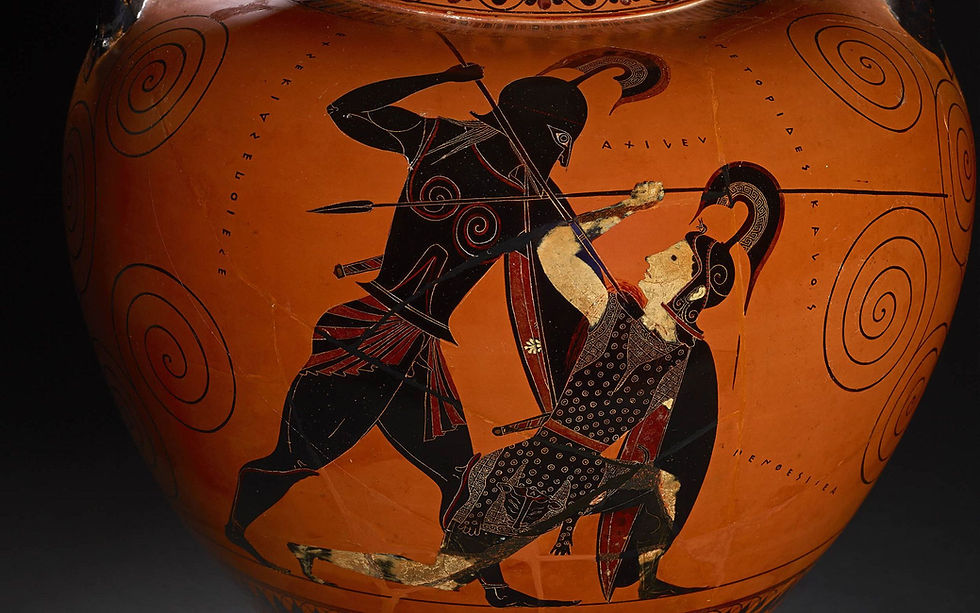
Consider the Greeks, who manage the extraordinary feat of being Greek for centuries before thinking to mention it. Homer's warriors know nothing of fighting for Hellas or invoking "the Greek people" in their interminable speeches about honor and inheritance. In the Homeric poems, "Hellas" denotes a specific northern region, not the entire Greek world.[1] The warriors of the Iliad care about personal honor (timê), glory (kleos), and plunder (geras)—not national belonging. Their loyalty runs to leaders and comrades. There are Achaeans, Argives, Danaans: labels that shimmer and overlap like oil on water, and signify much less than translators wish. Hellas exists, if at all, only as shared behavioral grammar—not the bounded nationalism of flags and treaties, but a loose sense of belonging more to these rules than to people who operate by none at all. Yet nothing feels provisional. When Odysseus washes ashore, he knows exactly how supplication works. Hospitality has rules. Oaths bind. Insults escalate in familiar rhythms. The system hums with complete confidence while remaining utterly unconscious of what it is.
This exposes the error most theories of identity make at the outset: they assume identity begins as an idea, something people conceive and then perform. Really, it begins as liability. A people exists when belonging determines who must respond when something goes wrong. Who avenges a death. Who answers an insult. Who guarantees a marriage. Who bears responsibility when trust collapses. Identity is not who you say you are. It is who cannot walk away without highly destructive consequences. Greek tribes are not ethnic seeds waiting to blossom into Romantic nationalism. They are shock absorbers. They exist to narrow exposure in a volatile world where violence is ubiquitous and enforcement local. They tell you how far consequences travel before dissipating into indifference. This is why genealogy matters so obsessively in Homer—and why it remains so flexible. A hero's lineage is not historical fact; it is a pricing mechanism. It tells you what this man's anger costs, whose obligation his death creates, which doors his daughter opens. Kinship is not sentiment. It is deferred debt. A tribe is simply the smallest social structure capable of absorbing crisis without exploding. Once you see tribes this way, that is as liability pools rather than ethnic containers, the convergence of Greek life across the Aegean stops looking mysterious. No central planning is required as repetition does most of the work: marriage and funeral rites cannot be improvised; cult must be performed on schedule; prestige must be displayed publicly or it evaporates. Because these obligations are expensive and high-stakes, practice standardizes. Aristocratic women marry out, carrying household cult, weaving technique, and kinship reckoning with them. Their children grow up bilingual, code-switching without thought. A small number of men (aristocrats, craftsmen, mercenaries, priests) circulate constantly between communities for festivals, arbitration, games and war. Most people never travel at all. But it is enough. Norms move faster than bodies. Identity scales through overlap, not constitutional convention. The great Panhellenic sanctuaries do something more interesting than symbolize unity. They are factories of behavioral standardization. Olympia, Delphi, Dodona, Isthmia: these places compress difference through ritual repetition.[2] You show up, sacrifice, compete. You witness oaths. You defer to priestly authority. You watch your rivals do the same. Over generations, this produces a shared operating environment without anyone deciding to build one. The games do not celebrate Greekness; they manufacture it, one tedious protocol at a time. Language follows the same logic. Greek does not converge because anyone defends it—there is no Académie française in Homer. It converges because diverging is expensive. If your dialect ceases to be mutually intelligible, you are severed from trade routes, marriage networks, and anyone who might arbitrate disputes. The poetic tradition preserves an older elite register not as artificial antiquarianism but as the residue of centuries of contact. When Homer uses forms spoken nowhere in his own time, he is not inventing tradition; he is exploiting shared inheritance. His verses work because audiences already possess the grammar of expectation. They know what a hero sounds like because they have heard these patterns before, in songs their grandfathers memorized. By the time you can meaningfully contrast Greeks with non-Greeks—say, by the sixth century—Greeks already recognize each other instinctively. Not because they share a flag or founding myth, but because they share a rubric. They know how another man will calculate honor against advantage; they know how far hospitality obliges protection of a guest; they know what an oath is worth and what breaks it. This is not ideology. It is a shared decision-environment, a reduction in the number of plausible futures. Its great achievement is that it requires no explanation. "Hellas" surfaces only when forced. The Persian Wars do not invent Greek identity; they compel its abstraction. Suddenly comparison is unavoidable. Herodotus must explain why these people, who fight each other constantly, are somehow all the same kind of thing. He reaches for "of one blood and one speech, common shrines of the gods and common sacrifices, the manners and customs which are the same" (8.144.2)—a list that manages to be both obvious and insufficient. What actually binds Greeks is harder to articulate: they share a social syntax, a way of calculating obligation that feels natural to them and alien to Persians. Hellenism surfaces not as awakening but as retrospective filing. It is an index created when habit alone can no longer absorb the strain. If identity were merely an idea, this would end the story. The light of consciousness falls on Greekness; the magic dissipates; the Greeks either become something new or fade into Alexander's universal empire. But that is not what happens. Instead, Hellas begins a far stranger and more revealing transformation.
The Trick of Descending Levels
Under Rome, Hellas loses sovereignty completely. Greek poleis become provincial cities. Greek kings disappear. Greek armies disband. And yet Greekness not only survives—it conquers its conquerors. It does so by changing what kind of thing it is. The mechanism is straightforward: Greek stops being a political identity and becomes a cognitive one. It descends from the level of statehood into the level of thought, maybe even intellectual branding. To be educated in the Roman Empire is to read Greek. Philosophy is Greek. Medicine is Greek. Rhetoric is Greek. If you want to sound intelligent, you quote Homer. If you want to sound sophisticated, you affect Attic mannerisms. The man who governs you speaks Latin; the man who teaches your son speaks Greek. This is not resistance; it is not even particularly dignified. It is demotion without erasure. This works because Greek is already infrastructure by the time Rome arrives. Alexander's conquests and the successor kingdoms—the Ptolemies in Egypt, the Seleucids in Syria and Mesopotamia, the Antigonids in Macedon—had spent three centuries making Greek the language of administration from Sicily to Afghanistan. When Rome conquers, it inherits a world already running on Greek courts, Greek record-keeping and Greek schools. Replacing this would cost more than adopting it. Latin handled military command and Roman law because those were new impositions. Everything else—the cities, the trade networks, the educated classes—operated in Greek. Rome did not so much choose Greek as its cognitive language as inherit it as the previous tongue of dominion. Rome needed an imperial culture, not least because administrators need to think in universal categories—justice, virtue, the good—and the Greeks spent centuries arguing about those in expensive detail. So Rome rules, and Greece repatterns Roman cognition from below. By the second century AD, the Roman emperor writes philosophy in Greek. Byzantium repeats the maneuver with even less fanfare. People sometimes treat the triumph of Greek in Constantinople as either mysterious or some sort of Hellenic treachery—the empire was Roman, after all, so why did it end up speaking Greek? But there is no mystery. Latin retained specific high-state functions—governance, military command, elements of high law—while Greek carried the empire's everyday administrative, ecclesiastical, educational, and commercial load in the East. As soon as the Western Empire fell, what was the point of pretending the ratios were reversed? Latin could have been maintained as a symbolic language of power, the way Sanskrit persisted in India. John Lydus or, slightly more pointedly, John Lydos, blamed institutional decline on abandoning "the ancestral language," linking the shift to Greek with a loss of Roman fortuna—and this attitude lingered after Rome fell.[3] But this was a game only elites could afford to play, and even then not for long. So "Hellas" remains an ambiguous, faintly suspect term—it sometimes means "pagan"—but the empire runs on Greek. The liturgy is Greek. Theology is Greek. Law is Greek. Provincial administration is Greek. If you want a career in the imperial service, you learn to write in an increasingly arcane register claiming continuity with classical Attic. This is absurd in a wonderful way: a Christian empire defines itself as Rome while being located 900 miles east, speaks Greek but treats "Hellene" as a term of abuse. Identity begins to resemble layers, and politics becomes the art of highlighting the useful ones. From the eleventh century onward, elite authors like Psellos begin reclaiming "Hellene" in cultural terms—a marker of paideia, of Greekness defined through education and intellectual lineage rather than paganism.[4] After 1204, the term takes on sharper collective force. Crusaders sack Constantinople, and Latins who theoretically owe sovereignty to the city they bring down, also destroy the whole edifice of imperial universality. What re-emerges in the fragmentary successor states is something harder-edged: Hellas as memory, Hellas as loss. The scholars of Nicaea use "Hellene" differently. Not as pagan, not quite as ethnic label, but as a way of naming what they once were and might be again. The identity surfaces when the structure that submerged it collapses, but not necessarily in a pristine form; in fact, there is a reactive force to it. Survival Without Dignity The Ottoman conquest pushes this logic to its limit. Hellas shrinks until it is cheap enough to survive on the equivalent of rations. No state, no army, no court, no prestige. What remains is a millet, or identity as pure function. The Patriarch negotiates on behalf of the Orthodox community; the community maintains schools; the schools teach Greek; Greekness becomes circular, minimal and extraordinarily durable.
Western Enlightenment observers find this baffling and depressing. Where are the heirs of Pericles? Who are these tax-paying Ottoman subjects who speak a debased dialect and know nothing of Plato? But this misunderstands what is happening. Survival under empire is not about preserving content; it is about maintaining function. Hellenism endures because it continues to do work: it coordinates marriage, transmits literacy, manages communal property, provides alternative jurisdiction when Ottoman courts are unavailable or undesirable. This is not glorious but it keeps the system load-bearing.
The nineteenth century then does something very strange. Western philhellenes—who have spent centuries idealizing ancient Greece while ignoring its actual descendants—suddenly decide that modern Greeks are Worthy of Rescue. Greek independence becomes a European cause. Byron dies at Missolonghi. A Bavarian prince becomes king. The new Greek state is handed an impossible identity: you are the heirs of Athens and Sparta, minus the Byzantine millennium that actually sustained you, minus the Ottoman structures that kept you coherent, plus a neoclassical fantasy invented in German universities.
This is identity as taxidermy. And yet even here, it does not collapse. It contracts again, now burdened by an absurd weight of expectation, but it continues to function. Greeks marry Greeks. They speak Greek at home. They teach Greek history, even if the history they teach is partly fabrication. The mechanisms remain load-bearing, even when the labels are incoherent.
None of this is unique to the Greeks. The English pull off the same trick in fast-forward after 1066. Englishness loses catastrophically. The court speaks French. The church speaks Latin. English gets shoved out of every prestigious domain and sinks into the background hum of everyday life. Peasants, craftsmen, parish clergy; household management, field work, market transactions; the language of people who don't matter at all.
By most reckonings, English should have evaporated. Instead it dropped levels and waited. And because it dropped into the domain of default behaviour—the lowest-energy way to get things done when no one important is watching—it became indispensable in a way prestige never quite manages. By the fourteenth century, when Parliament needed to communicate beyond barons and bishops; when law courts needed witnesses who actually understood proceedings; when royal administration required literate clerks who weren't all clerics, English was already carrying that load. French had prestige; Latin had God and learning; but English had the advantage of being what everybody already used to solve everyday coordination. It surfaced not because anyone championed it, but because universalizing the alternatives would have been more expensive than continuing to pretend it didn't exist. The Pattern The pattern is now visible. Real identities do not persist by remaining unchanged. They persist by changing what kind of thing they are. When they hold power, they operate at the level of state and sovereignty. When defeated, they descend into cognition, education, liturgy. When driven lower still, they become household practice, marriage custom, the default language of getting through the day. They shrink until they are cheap enough to survive. And when circumstances shift, when the structures that replaced them weaken or require what they provide, they surface again—altered, refunctioned, but recognizably continuous.
This is why the standard debates collapse. Peoples are not primordial billiard balls bouncing intact through history; they shatter under pressure, and the pieces rearrange. But they are not mirages conjured by nationalist intellectuals either; those evaporate under loss. Real identities do neither. They sink, adapt, wait. They remain load-bearing by solving coordination problems under conditions of uncertainty. When they work, they are invisible. When they strain, they surface. When defeated, they descend. When needed again, they return altered but intact, because the function they perform is still cheaper than the alternatives.
This is not a Greek peculiarity. It is not an English peculiarity. It is how human continuity actually works, in all its undignified persistence.
NOTES
[1] Iliad 2.683–684. The standard discussion of early Greek identity remains Jonathan M. Hall, Ethnic Identity in Greek Antiquity (Cambridge, 1997); for Panhellenic consciousness in the archaic period, see Gregory Nagy, The Best of the Achaeans (Baltimore, 1979). [2] Catherine Morgan, Athletes and Oracles: The Transformation of Olympia and Delphi in the Eighth Century BC (Cambridge, 1990); Irad Malkin, A Small Greek World: Networks in the Ancient Mediterranean (Oxford, 2011).
[3] John Lydus, De Magistratibus 2.12 (ed./trans. A. C. Bandy, On Powers or The Magistracies of the Roman State, 1983), with the key Greek sentence beginning “Κύρου γάρ τινος Αἰγυπτίου…” and ending “τὴν Τύχην ἀπέβαλεν ἡ ἀρχή.” [4] Anthony Kaldellis, Hellenism in Byzantium: The Transformations of Greek Identity and the Reception of the Classical Tradition (Cambridge, 2007), esp. ch. 4–5 on the Komnenian reclamation of Hellenic identity.


I would think Greek identity meant a belief in eternal gods. The world changes but the gods don't. The sacred isn't mutable. Modern liberalsim's gods are ersatz sacred victims, symbolized in the form of Kneeling Nancy. They are Duchampian urinals of emptiness and irony.