


The View from the Upper Gallery
Updated: Oct 2
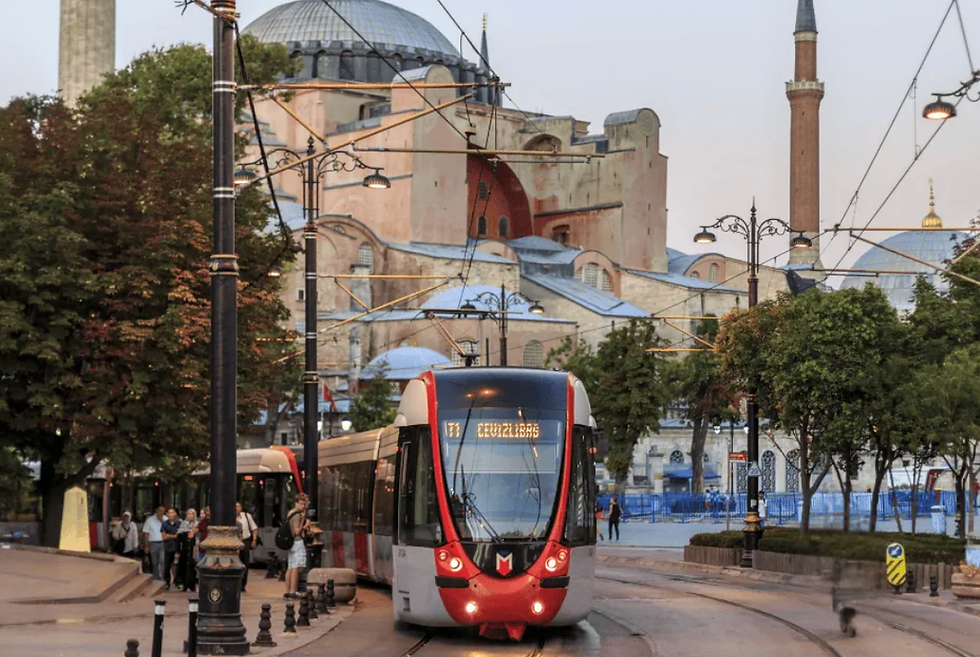
From a converted cathedral to an annulled degree, Erdoğanism shows how procedure can be made to escort power to a destination it wanted all along, and how little the liberal order has to say about it.
It has been 2,360 years since Alexander the Great crossed the Hellespont and yet, thanks to a particular kebab, his name is still handed to Turkish waiters alongside requests for extra yoghurt. A casual visitor might think this proves the Hellenic conqueror never left Anatolian hearts but the countless kebab signs actually point to İskender Efendi, the Bursa cook associated with turning the roasting spit upright, shaving the lamb thin and serving it over pide, tomato sauce and sheep butter. The Aristotle-educated breaker of Persia, fever dream of every undergraduate, is passed over in favour of a folksy Turk.
He’s not the only one. Turkey is full of names that have survived by changing jobs. Rumi, a Persian born in Khorasan, became a Turkish poet; Sinan, the Cappadocian Christian, became the greatest Turkish architect; Hagia Sophia, the greatest cathedral of the East, is sometimes a mosque, sometimes a museum. The old forms remain visible while, behind twitching curtains, permissions shape-shift.
Nowhere is this dynamic more evident than in the country’s leadership. Turkey’s president, Recep Tayyip Erdoğan, for example, remarked in an interview given to Milliyet in July 1996, that democracy was like a tram. You rode it until you reached your stop, then got off. And he was as good as his word. What nobody anticipated was that getting off did not require a coup or a suspension of elections, only the patient redefinition of what every term in the democratic contract actually meant — who counts as a candidate, what a degree certifies, what a party congress decides, what a court finds. The tram kept running. It still runs. Yet Erdoğan alighted years ago. What remains are the timetables, the stops, the cheerful recorded announcements — democracy as rolling stock.
No building makes the terms of engagement clearer than Hagia Sophia. When Atatürk secularized it in 1935, the Republic effectively declared that the greatest of Byzantine monuments belonged to everybody, a claim with obvious theological defects but not a few practical benefits too. The carpets that had covered the marble floor for centuries were lifted, revealing the original surface for the first time since the Fossati brothers' restoration. The plaster hiding the mosaics was stripped back. The building became a museum, which may have robbed the place of a liturgical life and exposed it to the ignorant gaze, and yet, despite being mute, it still remained the great enchantress that had converted entire nations through the beauty of a single seraph. It stood, the sole apostle of stone.
This was not the first time the mosaics had been uncovered and then hidden again. When sultan Abdülmecid commissioned the Fossati brothers to restore the building in 1847, they uncovered mosaics hidden under plaster since the conquest. The sultan personally followed the emergence of each image and demanded that all be revealed, only to order them covered again, sharia being what it was, though he allegedly remarked to the Swiss architects that they might one day be uncovered "if times changed." The Fossatis obliged, painting over their discoveries with Justinianic geometric patterns so that suppression wore the costume of continuity (today the originals are preserved in records at the cantonal archives of Ticino).
Then, in 2020, Erdoğan returned the building to mosque status, scheduling the first Friday prayers for July 24, the 97th anniversary of the Treaty of Lausanne. Actions that work nicely as a proxy for what has changed over the last two decades across Turkey. Now, you pay 25 euros at the tourist entrance on the north-east side of the building, away from the main ceremonial entrance on Sultanahmet Square, which is for worshippers and costs nothing. You are directed up a stone ramp into the upper gallery, a narrow balcony circuit that takes roughly 20 minutes at the pace permitted by other visitors performing the same devotional shuffle of camera, phone and rented audio.
The ground floor, with its vertiginous nave and extraordinary marble floor — pale grey-white stone worn in waves like a sea frozen mid-swell — belongs to worshippers. Professional guides have been barred from operating inside. The city museum pass fails at the door because the building is administered by the Diyanet, the Presidency of Religious Affairs, which runs its own dispensation, fiscal as well as spiritual.
Inside, the scaffolding is half justified. Constantinople is a city haunted by earthquakes (AD 557 famously almost levelled the entire city) and Hagia Sophia has earned the right to structural anxiety. The dome has been tugged out of true by time, tremor and the optimism of earlier engineers. Yet the steel towers have taken up residence less like temporary supports than a permanent feature — the building made to perform its own decrepitude, a walking stick forced on a man whose stride is still good enough to resent it.
The mosaics of Christ and the Virgin in the main apse are concealed behind white curtain-sails during prayer, and since nobody has got round to automating the system, they tend to stay closed long after the last worshipper has left. Fortunately, the Deësis in the upper gallery, a mosaic of such unbearable sorrow that it stops visitors like a hand on the chest, is still accessible, which is more than can be said for the mosaics on the ground floor, now removed from the ordinary visitor's encounter with the building entirely.
The omphalion, the great polychrome marble disc in the southeast quarter of the nave, the spot where emperors were crowned, the navel of the world, the new Delphi, is still there. Much of the floor may now be covered in a shade of turquoise that even a municipal pool might blanch at, but preservation of the imperial spot remained of paramount importance. This may be an inkling of an archaeological conscience. More likely, it is the courtesy that power extends to power across centuries, regardless of faith or dynasty. One throne recognises another.
The visitor is made to understand, fairly rapidly, that access is being granted on terms not too dissimilar from seeing a tiger at the zoo. It is still magnificent, which is half the cruelty of it. Magnificence survives, and survival becomes part of the humiliation because everything worth approaching has been made available only on someone else's terms.
The Chora, now the Kariye Mosque, followed suit after a four-year restoration in 2024. There, the injury is smaller yet more telling, for the same reason that a bishop annexing a minor Islamic shrine of no devotional consequence to his faith would be more revealing than his seizing a great mosque. It shows the logic has outrun its justification. Hagia Sophia could at least be argued as a necessary hostage on symbolic grounds but the Chora is a rounding error in terms of Islamic patrimony. A small church on the western periphery of the old city, of consuming interest to Byzantinists and largely invisible to everyone else, converting it required no theological argument, just proof of power.
For its opening, Erdoğan spoke from Ankara by video link after UNESCO had reminded Turkey of its obligations. Here, the mosaics in the narthex and funerary chapel remain unimpeded and, most wonderfully, at the intimate scale the church permits (its corridors narrow enough that the gold ground seems to breathe on you) the images arriving with a force that Hagia Sophia's majestic distances cannot quite replicate.
Chora, as its name might suggest, insists on foregrounding the land, the countryside, and the mosaics certainly push the message home. Christ is inscribed above the entrance as the Land of the Living (ἸC XC, ἡ Χώρα τῶν ζώντων); the Virgin, opposite, as the Container of the Uncontainable (MP ΘV, ἡ Χώρα τοῦ Ἀχωρήτου). Theodore Metochites, the scholar-statesman who paid for all of it, kneels before an enthroned Christ in the lunette above the inner door, wearing a melon-sized hat (skiadion) of such obscene absurdity that it threatens to steal the show from the Son of Man.
In the parekklesion, the funerary chapel he built for his own burial, the Anastasis fresco shows Christ harrowing Hell, seizing Adam and Eve by the wrists and yanking them from their tombs in an image of such physical urgency that it makes the other traditions of resurrection look politely theoretical. The artist, and his patron, clearly loved the idea of a God who grabs us (Ὁ Θεὸς ὁ ἁρπάζων). This is what is covered during prayer, according to a rhythm that, again, is dependent on whether anybody has bothered to remember the rules. And, yes, again, there’s a steep entrance fee. Again, the museum pass fails and,yes, on Friday it is closed.
Nobody questions any of it because Ottoman revivalism is genuinely popular, a fact that liberal commentary has never quite been able to digest. Something was amputated in the twentieth century and then handed back to Turks as modernization. The old alphabet went. The caliphate disappeared. The fez vanished. Much of the empire's human variety went too, by massacre, exchange, departure, pressure and the ugly efficiency with which new states tidy old worlds. The Republic asked its citizens to call this progress, and for a while many did, because that century was replete with countries calling truncation purity.
Erdoğan's achievement has been to make "return" feel plausible, desirable, even necessary. Ottoman language courses reappeared in the curriculum around the same time Darwin was removed. Imam-hatip schools expanded. The Diyanet swelled from religious office into a vast machinery of sermons, payroll, foreign outreach and domestic supervision, running tens of thousands of mosques and acquiring a budget that would make leading ministries blush.
It’s the chief beneficiary of a political economy that sees a sacred revival being wired into lira, contracts and television studios. The firms that critics call the gang of five — Cengiz, Limak, Kalyon, Kolin and Makyol — did not merely build airports, roads and bridges but mosques too. Kalyon Group, for example, built the Çamlıca Mosque (the largest in Turkey) and within the same fiscal period held billions in state-guaranteed infrastructure contracts. The currency can collapse, households go without basics, and still the right companies remain protected by guarantees indexed to dollars or euros while domestic costs sag in lira. A circuit that's both sufficiently pious for Friday prayers and ruthless for a procurement lawyer.
This is the New Turkey beneath the ablutions. The mosque belongs to the machine — a spiritual totem plugged into contracts, media ownership and the sentimental circuitry of national grievance — and in that sense Erdoğan has understood something that technocrats forgot: that Man does not live by GDP alone; that people will endure a great deal if they believe their humiliation is being redeemed, especially if that stoicism is broadcast as common sense.
Civilisational language has force because it is rooted in something real. Treating Ottomanism as cosplay is one of the main reasons outsiders misunderstand it. The old world still has juice in it. In the West, such a politics is often dismissed by those who think a society can survive indefinitely on procedural legitimacy, greater diversity for consumers, and museums with apologetic wall text, but Erdoğan has made a different wager, which frames the mosque as the homecoming.
The wager works because, for many, the homecoming feels real. Most fundamentally for the first- or second-generation migrant who arrived in the working-class suburbs of Istanbul or Ankara carrying conservative values into a city that had spent decades making clear it found those values embarrassing. Perhaps his grandmother could not wear a headscarf to university, or his religious schooling was restricted by the same state that called the restriction enlightenment. For him, the Diyanet's expanding payroll, the imam-hatip schools, the Çamlıca Mosque visible from the Asian shore are not symptoms of backsliding but a democracy finally facing the right direction.
Erdoğanism did not manufacture this grievance. It found and named it, before restoring its pride. That this alchemy also serves a new class of oligarchs, media barons, and construction tycoons is not a contradiction the voters care to see. Besides, such details are easily lost in the glare of a resurrected empire. But Erdoğanism does not get to choose every inheritance it would administer.
In the president's ancestral Black Sea region, the mountains around Trabzon still contain villages where Muslim Turks speak Romeyka, a form of Pontic Greek so archaic that linguists prize it for preserving features lost elsewhere. There, the infinitive (e.g., using forms like epethámena "to die") which standard Greek lost centuries ago, still survives. Its speakers are Muslims whose ancestors converted in the Ottoman period, stayed through the cataclysmic population exchanges and carried the language in their mouths like an ember history forgot to extinguish — a living record that could be presented to the world as proof of the peninsula's bewildering depth; proof that Anatolia absorbs and transforms as much as it erases. Instead, today, this small miracle enters the field of security unease because living inheritances are treated as dangerous when they cannot be curated.
Many years ago, a Pontic Greek, eschewing the modest clothes of her peers, insisted that she had not originally set Pontus against Turkey, but that the state's approach to her homeland had the effect of alienating her. The region, for her, was the crown jewel of Anatolia, a place of belonging so deep it predated the categories the modern state had imposed on it. What enraged her was being conscripted into someone else's separatist narrative purely on the basis of ethnic inheritance, as though centuries of demonstrated loyalty counted for nothing against the accident of a grandmother's tongue.
For most Turks "Pontus" still summons separatism, Greek irredentism, population exchange, Christian ghosts and the suspicion that Anatolia remains full of ancient trapdoors that will catch poor unsuspecting Turks off guard. When Erdoğanist media wanted to poison Ekrem İmamoğlu's reputation, for instance, it was with good reason it reached for his Black Sea origins and insinuated Greekness, the old crypto-Hellene smear dressed up for the TV age. In its more fevered form, the charge made him sound like a Byzantine sleeper agent, presumably waiting for the right moment to revert the Queen of Cities to Constantinople while arranging a date with the ecumenical patriarch near the omphalion.
The accusation fed many appetites at once. If even the “son of an imam” (the meaning of his surname) can be made to sound foreign, who is safe? Istanbul, always faintly suspect in the Anatolian hinterland as a city too imperial, too cosmopolitan and too pleased with itself by half, looms in the Turkish imagination (in a funny mirror of the overly zealous Byzantinist's) as a staging post for Byzantine revanchism.
In the end, even the patriarch was dragged back into the theatre, still pressed down by a state that refuses to recognise his ecumenical title, denies the patriarchate legal personality, and has kept the Halki Seminary closed since 1971 on grounds that have not prevented the proliferation of dozens of private universities across Turkey since. This time, hostility bled directly into the judiciary; to codify the media's nationalist conspiracy, a senior prosecutor went so far as to formally insert an unsigned, anonymous letter into İmamoğlu’s criminal case file questioning his family's ancestry and alleging hidden ties to Greece. A significant share of the audience understood the insinuation against İmamoğlu without requiring subtitles, which tells you something about both the intellectual weather that the Diyanet's weekly sermons have helped cultivate, and the deep reflexes of the electorate itself.
Talking of Halki, perched above the Sea of Marmara on Heybeliada, it has recently been restored in works funded almost entirely by Athanasios Martinos, a shipping billionaire whose family fortune runs to some $2 billion. A family that now has the dubious honour of having paid to rebuild the same complex twice in 130 years, having stepped in after the earthquake of 1894 flattened the original. In gratitude, the Patriarch awarded the former civil governor of Athos (2019–2023) the title Archon Exarchos and Ecumenical Grand Benefactor, President of the Brotherhood of Archons of the Great Church of Christ Panagia Pammakaristos... because why say something in seven syllables when you can say it in two dozen.
Erdoğan has promised the seminary’s reopening to U.S. president Donald Trump but currently it stands empty and immaculate on its hill, like everything else in this story that has been maintained without being returned — the shell gleaming, the permission outstanding, the first students awaited in September 2026 by anyone optimistic enough to keep counting — and by an ever-retreating 2027 by everyone else.
Pontus' Sümela Monastery offers similar lessons. The state invests in roads, restoration and tourist infrastructure at the cliffside monastery of the Virgin in the Pontic mountains, because still-born pluralism is photogenic and pays. With Orthodox worship, however, the gloves come off. The annual Divine Liturgy has been refused, shifted, permitted late, capped and generally treated as though prayer itself were a security incident disguised by incense. The whole dynamic is as if Budapest turned Gül Baba's tomb into a secular tourist attraction, forbade Islamic ritual, then congratulated itself for its role in the preservation of Ottoman heritage.
Such patterns had already been rehearsed at the Hagia Sophia of Trebizond, which was converted to a mosque in 2013, seven years before the Istanbul experiment.
There, in the apse, the Dormition anchors the eye with a radical compositional shock that lays bare the terrible math of the incarnation. The Virgin lies spent on her bier, a heavy horizontal block of deep indigo, surrounded by the earthbound grief of the apostles. She has paid the ultimate human price for her submission, losing her Son to the world in the most agonizing way possible. Yet cutting through this mortal horizon is the vertical axis of a living God who refuses to make his mother wait for the Second Coming. Emerging from a shroud of gold light, Christ bends down to play the midwife to his own mother, cradling her miniature, white-wrapped soul into his arms like a newborn. It is the great boon of her awful mission, captured in a single, terrifyingly tender masterstroke: the incarnation running briefly in reverse at the moment of greatest loss.
This is what the retractable ceiling covers during prayer. And because nobody rioted, and the international community didn’t escalate past the customary expressions of concern, Ankara took note. A court later ordered the frescoes made visible outside prayer hours. Implementation has been episodic.
II.
The church is locked. It has been so, according to the tea-shop owner across the street, since Tuesday, when the bekçi went to visit a cousin in Üsküdar. He will return, possibly Thursday, possibly the week after. The tea-shop owner is not entirely sure that the bekçi has a cousin. He argues with another customer about this until the conversation moves on to more pressing matters.
The Church of Christ Pantepoptes was built in the eleventh century by Anna Dalassene, mother of Emperor Alexios I Komnenos, and it is one of the finest surviving examples of middle Byzantine architecture in the city. It sits on a hillside above the Golden Horn in a state of quiet anxiety and it is, again, locked. To enter, you locate the muhtar, who locates the imam, who locates the specific old man with the specific ring of keys, who may or may not be having lunch. The Church of Hagios Theodoros nearby has its courtyard secured with a heavy iron chain. Historians have been known to wait hours at the kiraathane across the street, hoping someone will recognise them as a harmless academic and call Uncle Ahmet to come down.
This is the minor key of what Hagia Sophia performs in the major. There, the mechanism is ticketed, signposted, administered by a directorate with a budget. Here, in the backstreets of Fatih and Fener and Çarşamba, a dozen Byzantine churches function as neighbourhood mosques with almost zero daily attendees, which means the Diyanet sees no reason to fund permanent staff, and access is instead gatekept by a man who, on ninety percent of any given day, has better things to do. The result is therefore always a building that’s inaccessible in practice.
A few streets from Pantepoptes, in Cibali, there is Gül Camii. A legend holds that when Ottoman soldiers breached the walls on May 29, 1453, they found this church full of roses — it was the feast day of Saint Theodosia, and the congregation had garlanded the columns in her honour. The soldiers named it the Rose Mosque, which it remains. The trick here to entering is to arrive at the call to prayer, wait respectfully at the back while the local congregation finishes, and then take a wander. In other words, the best access to a Byzantine church in Istanbul is granted by assimilating pronto to Islamic liturgical time. Again, the building is open but the terms are someone else's.
Meanwhile, the Boukoleon is most often encountered at speed, through a bus window, by people going somewhere else—the sea-facing arcade of marble and brick where Byzantine emperors embarked and crusaders found the relics of the Passion now marooned against the roaring asphalt of Kennedy Caddesi. The ancient imperial harbour was filled in for the highway in 1959, leaving the palace facade to share a narrow pavement with parked cars, its landward foundations already sliced in half by the Orient Express railway in 1873. The Tekfur Sarayı, by contrast, was restored in the 2010s and opened as a museum in 2019. The exhibition inside is devoted entirely to Ottoman ceramics. The Palaiologans, who held the palace in the empire's final century, are a footnote in the entrance hall.
III.
Istanbul in June still does its work on arrival. The Bosporus is unreasonable in its beauty and the warmth of Turks to strangers is a large reason many outsiders fail to notice the narrowing of public life. Nobody shouts “tyranny!” at the ferry terminal. The simit sellers shuffle through the crowd, the fishermen stand shoulder to shoulder along the Galata Bridge, the gulls steal bread, the cats wait for what the fishermen don't want. The water shines. Loss enters by smaller doors than tyranny requires.
People who knew the city in the years when the big tent still stood tend to describe the change as depletion rather than expulsion. The old Istanbul was hardly innocent — it could be chauvinistic, corrupt, exhausting and cruel — yet it had room for friction. Secularists, Islamists, Greeks, Armenians, Kurds, Alevis, nationalists, bohemians and provincial strivers occupied the same public spaces. Every district might host its own quarrels but the unresolved energy gave the city its charge. The tent came down quite gradually, which is why people still argue about the date, anf the city that replaced it has a very different metabolism. Today it is quieter in public, more devout in official posture, more uniform in the places where contradictions used to seethe and breathe.
Media capture supplied most of the anaesthetic. When the Doğan group — Hürriyet, CNN Türk, Kanal D, the whole architecture of mainstream opinion — was sold to the Demirören family in 2018, Aydın Doğan told the farewell ceremony that he was leaving willingly, without pressure, and that his friendships with journalists would continue to the grave. The acquisition was financed almost entirely through a low-interest loan from Ziraat Bank, a state institution, on terms that have never been made public and which the bank declines to discuss. Leaked recordings had already shown Erdoğan telephoning Erdoğan Demirören to instruct him on the framing of sensitive stories. Editors did not need a commissar at their elbow when the ownership had already performed the correction.
After that, many things became easier to present as normal. A museum can become a mosque with a ticketed tourist orbit; a monastery can remain heritage while worship is marginalised. The locked door ceases to require explanation when there is no longer any institution paid to notice it.
Into this relative calm stepped the mayor of Istanbul whose main fault was to beat the AKP in the city where Erdoğan's national ascent began (1994-1998). This made him more than just an opponent. It made him an insult to the president’s whole origin story, and therefore Turkey's general trajectory.
Then Istanbul University remembered something.
In March 2025, the university annulled İmamoğlu's bachelor's degree, citing irregularities in his transfer decades earlier from a university in North Cyprus. The alleged defect had survived almost four decades of institutional incuriosity; a fact that was rectified when he sought to become a presidential candidate (as hopefuls must hold a higher education degree cf. art. 101).
The next day, İmamoğlu was taken into custody. Then jailed pending trial. Later, prosecutors constructed a 3,900-page indictment of comic vastness, accusing him of leading a criminal network and seeking a sentence that could run beyond 2,000 years. Such numbers exist to dwarf the accused; to make the state feel geological; to inform the public that the defendant has passed beyond ordinary politics and into an existential landscape of national betrayal too large for any citizen to comprehend.
The degree business reveals the system. Nothing was invented, nothing abolished — the university, the legal requirement, the mayor's public prominence, the election on the horizon all remained exactly as they were. The document had simply been waiting in a drawer, quiet as an archive, available to anyone with political nous. Thirty-five years of institutional incuriosity resolved itself in an afternoon. A life of public legitimacy made to depend on a registrar's afterthought: it is the Fossatis' whitewash applied to a man.
By May 2026, the courts turned from the candidate to the machinery that had produced him. An Ankara court annulled the CHP's 2023 party congress, ousted Özgür Özel, and reinstated Kemal Kılıçdaroğlu—the former leader whose primary qualification was that he had already lost to Erdoğan. Under this new judicial dispensation, the chief requirement for leading the opposition was, rather conveniently, a certified track record of failure. The party's name, HQ, membership, and parliamentary presence were left entirely intact. What was removed was the assumption that a party could decide who led it—the same operation performed on a basilica, now performed on a ballot.
The old Islam-versus-secularism frame, despite its perseverance in western commentary, has become obsolete because one side won so thoroughly that it rewrote the terms of the argument. Islamism in Turkey did not merely defeat secularism but recast it as a foreign tool, an imposition of Kemalist elites acting on behalf of Western modernity against their own people. The mosque is new, shining and efficiently administered; the military is powerful and increasingly pious; the infrastructure is impressive. Secularism, meanwhile, is presented not as a Turkish achievement but a colonial residue. A political tradition that once defined the republic now has to prove it is not a fifth column before it is allowed to articulate, let alone participate.
IV.
The main maneuver, at the core of the Turkish state, is to ask the visitor to confuse visibility with possession. You can see Hagia Sophia. You can see Sümela. You can hear that Romeyka survives. You can watch elections and read court decisions. Yet what has changed is not the object but the route by which anyone may reach it.
The liberal reflex is to quarantine Erdoğanism as an exotic pathology, a product of Turkish history, Ottoman nostalgia, Anatolian resentment and one unusually gifted political animal. This is comforting, and therefore suspect. Erdoğan is not an exception to modern procedural power. He is its indecently visible form.
Under the president, the forms remain. Elections are held, courts issue rulings, universities produce decisions, parties convene congresses, ministries cite regulations etc. What has changed is the route by which outcomes are reached. The old promise was that procedure would constrain power. The newer discovery is that procedure can be made to escort power politely to the destination it wanted anyway.
This is why comparisons with Brussels are useful only if handled carefully. The European Union is not Turkey. Its institutions contain real legality, audit trails, negotiation, appeal, compromise and, often enough, sincere public purpose. When France and the Netherlands rejected the European Constitutional Treaty in 2005, and when Ireland rejected Lisbon in 2008, the rerouting that followed was not the work of a sultan with a registrar’s stamp. It came wrapped in reflection periods, guarantees and men in suits who believed, in many cases honestly, that they were saving Europe from its own worst instincts.
But good faith does not dissolve the mechanism. It merely civilises its appearance. A result proved unacceptable, so the route was altered until a tolerable version of the result could be obtained. The difference is vast in degree and morality, but not wholly foreign in form. The upper gallery is not always built by cynics. Sometimes it is built by people who are quite certain they know where the ground floor leads, and who experience the locked door not as coercion but as the reasonable management of a public too liable to mistake access for authority.
This is what Erdoğanism exposes: that the modern state has grown dangerously comfortable with forms that can survive the departure of the principle that once animated them. Erdoğan’s vulgarity is clarifying. He leaves the curtain visible as a curtain, the legalism audible as choreography, the institution intact and hollowed. He commits, in public, the sin that more respectable systems commit with better lighting.
The question, then, is not how many states have become pariahs. Pariah implies an inside that remains clean. The question is how many states still believe, operationally rather than ceremonially, that law, procedure and institutions are supposed to bind the people who command them. Erdoğan does not answer that question, he simply reveals that much of the liberal order has quietly stopped asking it.
And he has failed, along with everyone else, to restore the ground floor whose existence always justified the upper gallery. The upper gallery remains; it's the promise that's gone missing.


Comments